【探泌】BMC Urol:输尿管软镜钬激光碎石术后自助体位疗法的有效性分析
编者按
【Abstract】
Background: To observe the efficacy of self-help position therapy (SHPT) after holmium laser lithotripsy via flexible ureteroscopy (FURS).
背景:观察输尿管软镜(FURS)钬激光碎石术后自助体位疗法(SHPT)的有效性。
Methods: From January 2010 to November 2015, 736 nephrolithiasis patients who had received FURS lithotripsy were analyzed retrospectively. In position group, 220 cases accepted SHPT after lithotripsies, and 428 cases as control, coming from another independent inpatient area in the same center. The stone-free status (SFS) between two groups were compared at the 2nd, 4th and 12th week ends by X-ray examinations.
方法:回顾性分析2010年1月至2015年11月接受输尿管软镜(FURS)钬激光碎石术的肾结石患者共736例。实验组220例在碎石术后接受自助体位疗法(SHPT)。对照组428例来自同一医院另一独立病区。在术后第2、4、12周末,通过X线检查对比两组结石排净状态(SFS)。
Results: The preoperative incidence of hydronephrosis (25.9% vs. 18.0%, p = 0.018) or lower calyceal seeper (33.6% vs. 24.3%, p = 0.012) and the proportion of patients with > 2.0 cm stones (33.6% vs. 24.3%, p = 0.003) were all significantly higher in position group than in control group. There were no substantial difference between two groups in age, BMI, gender and medical histories. In postoperative followup, the incidence of hydronephrosis in position group was significantly lower than in control group (9.5% vs. 15.7%, p = 0.032) after removing double-J stents. In position group, the SFS of the 2nd week end (60.9% vs. 47.2%, p = 0.001), the 4th week end (74.1% vs. 62.8%, p = 0.004) and the 12th week end (86.9% vs. 79.4%, p = 0.021) were all significantly higher than those in control group.
结果:实验组术前肾盂积水发生率(25.9% vs. 18.0%,p=0.018)或下盏积水发生率(33.6% vs. 24.3%,p=0.012)以及2cm以上结石患者比例(33.6% vs. 24.3%,p=0.003)均显著高于对照组。两组间年龄、体重指数(BMI)、性别及病史无实质性差异。术后随访期间移除D-J管后肾盂积水发生率,实验组显著低于对照组(9.5% vs. 15.7%, p = 0.032)。在术后第2、4、12周末,实验组结石排净状态(SFS)显著优于对照组,分别为(60.9% vs. 47.2%, p = 0.001)、(74.1% vs. 62.8%, p = 0.004)和(86.9% vs. 79.4%, p = 0.021)。
Conclusions: SHPT after holmium laser lithotripsy via FURS may increase postoperative SFS, accelerate stone fragment clearance, and decrease the incidence of hydronephrosis after removal of double-J stents. The therapy does not require professional assistance and is economical, simple, and effective.
结论:输尿管软镜(FURS)钬激光碎石术后自助体位疗法(SHPT)可能会增加术后结石排净状态(SFS)、加速结石碎片排出以及降低移除D-J管后肾盂积水的发生率。这种方法无需专业性辅助,而且经济、简便、有效。
译者述评
随着光学成像及激光技术的快速发展,输尿管软镜(FURS)碎石术的地位愈加重要,但同时也存在术后结石残留导致感染、梗阻、疼痛等问题。通常认为直径≤2mm且无症状的残留结石无显著临床意义,但有研究表明,46%-77%残石会继续增大或融合,进而导致相关并发症。由于肾下盏解剖位置的特殊性,肾下盏残石更不易排出,上述问题处理起来更加棘手。近年来,体外物理振动排石(external physical vibration lithecbole,EPVL)相关设备的研发应用,改善了肾下盏残石不易排出的局面,但仍存在成本较高、需要专业设备和人员辅助、具有禁忌证和并发症等不足。
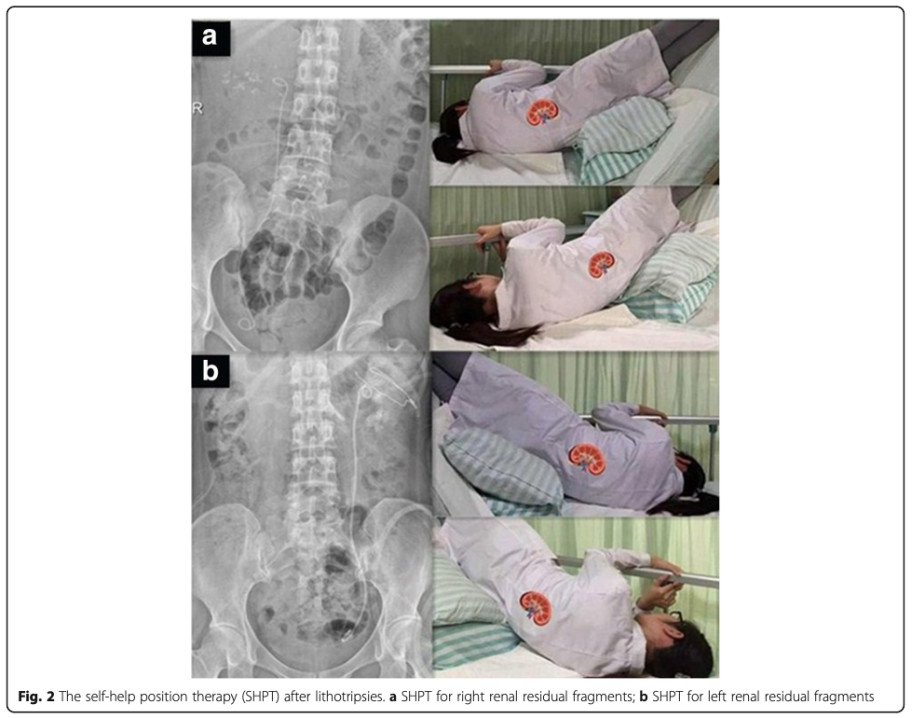
该项研究描述了一种促进术后结石排出的特殊体位——自助体位疗法(SHPT)。实验组术后接受SHPT,即每日健侧卧位并头低脚高倾斜至少45°,持续5分钟。对照组不采用任何体外物理排石手段。实验组和对照组均在术后口服坦索罗辛,每日饮水量2000ml。术后第2、4、12周末,通过放射学检查评估结石排净状态(stone free status,SFS),即无结石残留,或残留结石≤2mm且无症状。实验结果表明,自助体位疗法(SHPT)有效降低了术后结石残留及肾积水发生率,无需专业性辅助,具有经济、简便、有效的特点。
此外,SHPT是否可以联合体外物理振动以增加排石效果?肾盂肾下盏夹角(IPA)等因素是否会影响排石效果?仍需后续研究。
参考文献:
1. Yang J, Tao RZ, Lu P, et al. Efficacy analysis of self-help position therapy after holmium laser lithotripsy via flexible ureteroscopy. BMC Urol. 2018;18(1):33.
编译|王冬(陕西中医药大学附属医院)
编辑|榭小仙
审核|陈仁宗