【探泌】Int J Urol:等离子汽化法与金属扩张法在建立PCNL手术通道的应用对比:一项倾向评分匹配分析

编者按
皮肾通道的建立是经皮肾镜取石术(PCNL)至关重要的一步。建立通道的常用方法包括使用球囊的一步扩张法、使用Amplatz扩张器或Alken金属套叠扩张器的一步或逐步扩张法等。如何安全、有效地建立皮肾通道一直是临床热点话题。
对此,发表于《International Journal of Urology》杂志题为《Tract creation using plasma vaporization versus metal dilatation in percutaneous nephrolithotomy: A propensity score-matched analysis》的文章介绍了等离子汽化法在PCNL手术通道建立方面的应用。
【Abstract】
Objectives: To share our 10-year experience of tract creation by using plasma vaporization compared with metal dilatation in percutaneous nephrolithotomy.
目的:比较等离子汽化法与金属扩张法在建立PCNL手术通道的应用——10年经验分享。
Methods: We retrospectively reviewed the medical records of 230 patients who had undergone 244 percutaneous nephrolithotomy procedures at Kaohsiung Chang Gung Memorial Hospital, Kaohsiung, Taiwan, from January 2007 to December 2016, and divided the patients into the plasma (n = 130) and metal (n = 114) groups. All patients underwent percutaneous nephrolithotomy by either a bipolar resectoscope mounted with a plasma vaporization button electrode or metal dilatation for tract creation. Propensity score matching was applied to reduce selection bias. Perioperative and postoperative data analysis included procedure time, length of hospital stay, blood transfusion rate, any early and late complications, stone-free rate, renal function, and time of need for pain control.
方法:回顾性分析自2007年1月至2016年12月,高雄长庚医院230例患者共244例经皮肾镜取石术相关资料。将患者分为等离子汽化组(n = 130)和金属扩张组(n = 114)。所有患者均接受PCNL,分别使用带有等离子汽化纽扣电极的双极电切镜或金属扩张器建立手术通道。倾向评分匹配用于减少选择偏差。分析围手术期及术后相关数据,包括手术时间、住院时间、输血率、早期及晚期并发症、结石取净率、肾功能以及需要止痛时间。
Results: Before propensity score matching, there were significantly shorter hospital stay (2.6 vs 3.8 days, P < 0.01), less operating time (66.1 vs 108.1 min, P < 0.01) and no blood transfusion rate (0 vs 4 [3.5%], P = 0.031) in the plasma vaporization group. After propensity score matching, there was no statistically significant difference in the patients baseline characteristics. There were significantly shorter hospital stay (odds ratio 0.46, 95% confidence interval 0.32 0.66; P < 0.001) and shorter average operating time (odds ratio 0.98, 95% confidence interval 0.97 0.99, P < 0.001) in the plasma vaporization group.
结果:在倾向评分匹配前,等离子汽化组的住院时间显著缩短(2.6 vs 3.8 d, P < 0.01)、手术时间显著缩短(66.1 vs 108.1 min,P < 0.01)、零输血率(0 vs 4 [3.5%],P = 0.031)。在倾向评分匹配后,患者基线特征差异无统计学意义。等离子汽化组的住院时间(优势比0.46,95%置信区间0.32 0.66;P<0.001)以及平均手术时间(优势比0.98,95%置信区间0.97 0.99,P<0.001)显著缩短。
Conclusions: In comparison with metal dilatation, the plasma vaporization technique is a safe and effective method for creating the nephrostomy tract for percutaneous nephrolithotomy, based style="margin: 0px; padding: 0px; max-width: 100%; box-sizing: border-box; word-wrap: break-word !important;">
结论:与金属扩张法相比,等离子汽化法具有更短的住院时间及手术时间、零输血率、可接受的结石取净率以及无明显并发症等优势。因此,等离子汽化法是一种安全、有效的PCNL手术通道建立方法。
译者评述
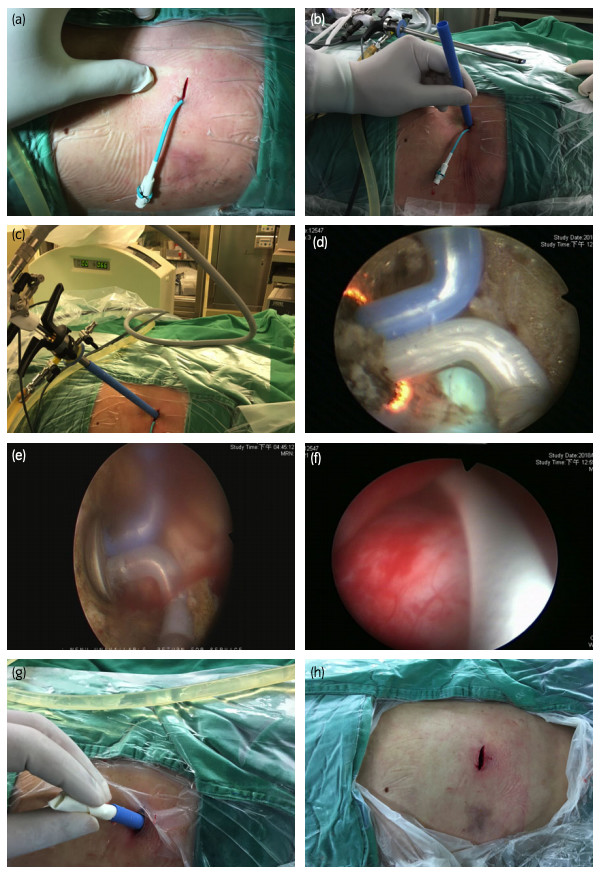
等离子汽化法具体步骤如下:在预先留置的肾造瘘管或导丝旁做一约1.5cm切口,经该切口将28-Fr Amplatz鞘置入皮下。通过Amplatz鞘,使用带有纽扣状电极的电切镜由浅至深将皮下组织、筋膜、肌肉及肾实质汽化蒸发,其中电切功率为250-300W,电凝功率为150W。建立手术通道后移除肾造瘘管,进行取石手术。取石结束后,向输尿管内顺行置入双J管,通过Amplatz鞘向手术通道内填塞3-4块明胶海绵。皮肤切口无需缝合,亦可做到无管化。
由于肾脏活动度的影响,尤其在对肾脏中下盏穿刺扩张时,传统扩张方法容易存在穿刺通道偏移或丢失的情况。原作者利用等离子电切镜在直视下沿肾造瘘管逐步汽化组织建立通道,并可同时电凝止血,确保了通道的安全有效。
总之,与金属扩张法相比,等离子汽化法的住院时间及手术时间更短、出血更少、结石取净率更高、并发症更少,是一种安全简便的建立通道的方法。值得一提的是,根据原作者的另一项研究显示,与球囊扩张法相比,等离子汽化法在安全性及有效性方面同样具有优势。
参考文献:
1.Chang YL, Chiang PH, Cheng YT, Lee WC. Tract creation using plasma vaporization versus metal dilatation in percutaneous nephrolithotomy: A propensity score-matched analysis. Int J Urol. 2019;26(2):223-228.
编译|徐煜宇(广州医科大学附属第五医院)
编辑|榭小仙
审核|李升