
【探泌】J Urol:完全输尿管内支架置入法与传统支架置入法在减轻输尿管支架相关性症状的有效性和安全性对比

导语
为贯彻落实中华医学会泌尿外科学分会“顶天立地”发展规划,加强国内外学术交流,促进我国泌尿外科事业更好更快发展,学习联盟特推出“探泌”栏目。本栏目秉承“专业,公益,共享,共进”原则,旨在传播学科发展资讯,搭建学术交流平台,更好地为我国广大泌尿外科同道服务。
上尿路取石术后常需放置输尿管支架,支架置入术后尿路刺激症状、血尿、腰痛等时常困扰着临床医生和患者,增加了医疗负担。如何减轻甚至避免支架相关性症状一直是临床热点话题。对此,发表于《The Journal of Urology》杂志题为《Efficacy and Safety of Complete Intraureteral Stent Placement versus Conventional Stent Placement in Relieving Ureteral Stent Related Symptoms: A Randomized, Prospective, Single Blind, Multicenter Clinical Trial》[1]的文章对完全输尿管内支架置入法与传统支架置入法在减轻输尿管支架相关性症状的有效性和安全性作了研究。
【Abstract】
Purpose: We compared the efficacy and safety of complete and conventional stent placement to relieve ureteral stent related symptoms.
目的:对比完全输尿管内置入法与传统置入法在缓解输尿管支架相关性症状的有效性和安全性。
Materials and Methods: We randomized 85 patients who required ureteral stent placement after lithotripsy into an intraureteral or a conventional stent placement group. The ureteral stent remained in place until postoperative day 14. We evaluated scores on the visual analog scale pain, the SF-36 (36-Item Short-Form Health Survey), the I-PSS (International Prostate Symptom Score) and the OABSS (Overactive Bladder Symptom Score) on postoperative days 3 and 14. We also assessed the total amount of analgesics administered and stent related complications.
材料与方法:将85例输尿管取石术后需要置入输尿管支架的患者随机分为完全输尿管内置入组和传统置入组。输尿管支架一直保留至术后14天。分别在术后第3天、第14天进行视觉模拟疼痛量表、SF-36、I-PSS以及OABSS评分。并评估镇痛药使用量及支架相关性并发症。
Results: Overall the records of 80 patients were analyzed. Pain scores were significantly lower in the intraureteral vs the conventional stent placement group (postoperative days 3 and 14, 4.85 vs 9.78, p = 0.003, and 3.15 vs 6.20, p = 0.014, respectively). The total I-PSS score (postoperative days 3 and 14, 10.41 vs 14.90, p = 0.006, and 11.67 vs 16.10, p = 0.022, respectively) and total analgesic use (19.23 vs 88.54 mg, p<0.001) were significantly lower in the intraureteral group. However, differences in the SF-36 and the total OABSS scores did not significantly differ. On subgroup analysis the pain score in the groin and bladder areas, incomplete emptying and daytime frequency on the I-PSS, the quality of life index and daytime frequency on the OABSS were significantly better in the intraureteral stent placement group than the conventional stent placement group on postoperative days 3 and 14 (all p <0.05). There was no difference in the complication rate between the 2 groups.
结果:最终收集分析80例患者资料。完全输尿管内置入组的疼痛评分显著低于传统置入组(术后第3天为4.85 vs 9.78,p=0.003,第14天为3.15 vs 6.20,p=0.014)。I-PSS总分(术后第3天为10.41 vs 14.90,p=0.006,第14天为11.67 vs 16.10,p=0.022)和镇痛药总使用量(19.23 vs 88.54mg,p<0.001)在完全输尿管内置入组显著降低。然而,两组间的SF-36以及OABSS总分无显著差异。其中,完全输尿管内置入组的腹股沟区和膀胱区疼痛评分、I-PSS尿不尽感和日间尿频评分、生活质量评分、OABSS日间尿频评分明显好于传统置入组。两组间的并发症发生率无差异。
Conclusion: Intraureteral stent placement may be associated with less ureteral stent related discomfort than conventional stent placement. This novel placement method is feasible and safe, and it can be immediately used in daily clinical practice.
结论:与传统支架置入法相比,完全输尿管内支架置入法具有更少的支架相关性不适。这种新颖的置入方法即可行又安全,可立即用于日常临床实践。
译者述评
上尿路取石术后留置输尿管支架在减少尿路感染、预防输尿管狭窄、促进结石排出等方面具有积极作用。但支架相关性症状如疼痛、血尿等仍是临床不容忽视的问题。虽然α-1受体阻滞剂、抗胆碱能药物、β-3肾上腺素受体激动剂已被广泛用于控制支架相关性症状,但也存在药物相关不良事件(如头痛、眩晕、口干、便秘等)及医疗费用的增加等不足。
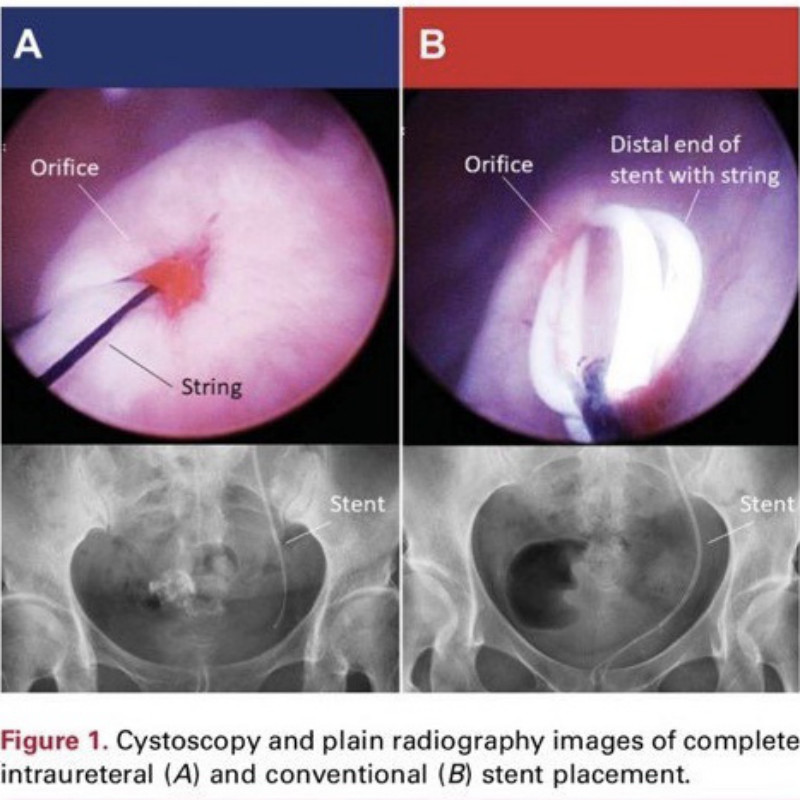
有研究表明,支架相关性症状与多种因素有关,如支架越硬、支架在膀胱内的长度越长(支架越过膀胱中线),症状越严重。该研究通过改变置入方法,避免支架对膀胱的刺激,并且保留了输尿管口的抗反流功能,进而减轻症状。需要指出的是,本研究使用的环形支架(loop-type ureteral stents)与国内较多使用的双J管(double-pigtail stents)不同,该环形支架末端更柔软,在膀胱内的材料更少、更易浮动,国内外相关研究表明,环形支架较双J管能够显著减轻支架相关性症状,故新式置入方法是否完全适用于双J管尚不明确,当然也可能更适用于置入双J管。
总之,该研究在减少支架相关性症状方面提供了一个很好的思路,随着新材料、新技术的发展,一定会有更多富有成效的研究成果问世。
【参考文献】
1.Yoshida T, Inoue T, Taguchi M, et al. Efficacy and Safety of Complete Intraureteral Stent Placement versus Conventional Stent Placement in Relieving Ureteral Stent Related Symptoms: A Randomized, Prospective, Single Blind, Multicenter Clinical Trial[J]. The Journal of urology, 2019, 202(1): 164-170.
责任编辑:榭小仙
审核校对:王冬 刘怀军